HREA / Education and training in support of human rights worldwide HREA celebrates 15 years
About Us | HREA News | E-Learning
Learning Centre Resource Centre Networks
Spanish French Russian Russian German Portuguese Italian Chinese Arabic
 
HREA Online - June/July 2008


IN THIS ISSUE


HREA celebrating UDHR 60

  • From the HREA staff: Disability rights convention enters into force
  • HREA evaluates Amnesty International's worldwide education programmes
  • HREA Director keynote speaker at Human Rights Watch


  • FROM THE HREA STAFF: DISABILITY RIGHTS CONVENTION ENTERS INTO FORCE


    Dear Colleagues and Friends,

    We had cause to celebrate when the Convention on the Rights of Persons with Disabilities entered into force on 3 May 2008. The Convention provides an important legal tool to ensure that the rights of persons with disabilities are respected, protected and fulfilled.

    According to the United Nations, there are more than 600 million people in the world with disabilities. They often not only face discrimination but physical and institutional barriers to the realisation of their human rights as well. Services and infrastructure in societies are often not taylored to all people to enjoy their human rights.

    When we consider how to practically implement the Convention on the Rights of Persons with Disabilities, accessibility is crucial
    . For example, if a wheel-chair bound voter cannot ascend the steps to reach a voting booth because there is no accessible ramp, then that individual faces a barrier to the right to participate in government and in free elections. The rights of persons with disabilities bring the issue of accessibility to the forefront, because inaccessibility is a significant obstacle preventing rights from being fulfilled.

    With very best wishes from the HREA Board and staff,

    Felisa Tibbitts
    Executive Director


    HREA EVALUATES AMNESTY INTERNATIONALS' WORLWIDE EDUCATION PROGRAMMES 


    HREA has been selected to conduct an impact assessment of Amnesty International's human rights education programmes in ten countries. Amnesty International"s Rights-Education-Action-Programme (REAP) focuses on "multipliers", people who through their work or position in society can teach or influence many others. Teachers, for example, are multipliers who work with school-children. In 2008 there are such REAP projects in Poland, Slovenia, Moldova, Russia, Turkey, Morocco, Israel, South Africa, India, Thailand and Malaysia. The REAP programme, which began in 2000 and concludes in 2009, is administered and funded by Amnesty International-Norway.

    The impact assessment's primary objectives include the improvement of human rights education by Amnesty International globally, as well as the improvement of project planning and management. Human rights education programming across Amnesty's various REAP projects have involved a range of themes and target groups, mainly teachers and educators in formal educational systems, but also NGOs, community leaders, journalists, prison officials, judiciary officers, religious officers and others. In Poland, Amnesty International is working intensively with school groups, fostering the initiation of student groups that are engaged with raising awareness, letter-writing and carrying out other self-defined activities to promote human rights in their community. In South Africa by contrast, a strong emphasis has been placed on integrating human rights within community development, where there is a focus on women's rights linked to HIV/AIDS.

    HREA will develop a multi-level evaluation design involving analysis of impacts on a multitude of actors: beneficiaries of trainings, "multipliers", key trainers, as well as on the organizational level. The data collection involves the administration of questionnaires as well as on-site visits to Poland, Malaysia, Morocco and South Africa. HREA's Director Felisa Tibbitts is the Team Leader for the evaluation and she will be working with local co-evaluators during site visits. The evaluation is scheduled to conclude in the fall of 2008.


    HREA DIRECTOR KEYNOTE SPEAKER AT HUMAN RIGHTS WATCH


    Felisa Tibbitts delivers keynote speech for Human Rights Watch at UCLAHREA Director Felisa Tibbitts was the keynote speaker at the Human Rights Watch Student Task Force sponsored Human Rights Education Conference at UCLA on May 3rd. In her keynote address "Human Rights Education: What? Why? How?" she gave an overview of the history and current state of affairs in human rights education (HRE) both in the USA and internationally. Approximately fifty educators and HRE stakeholders were present at the workshop.

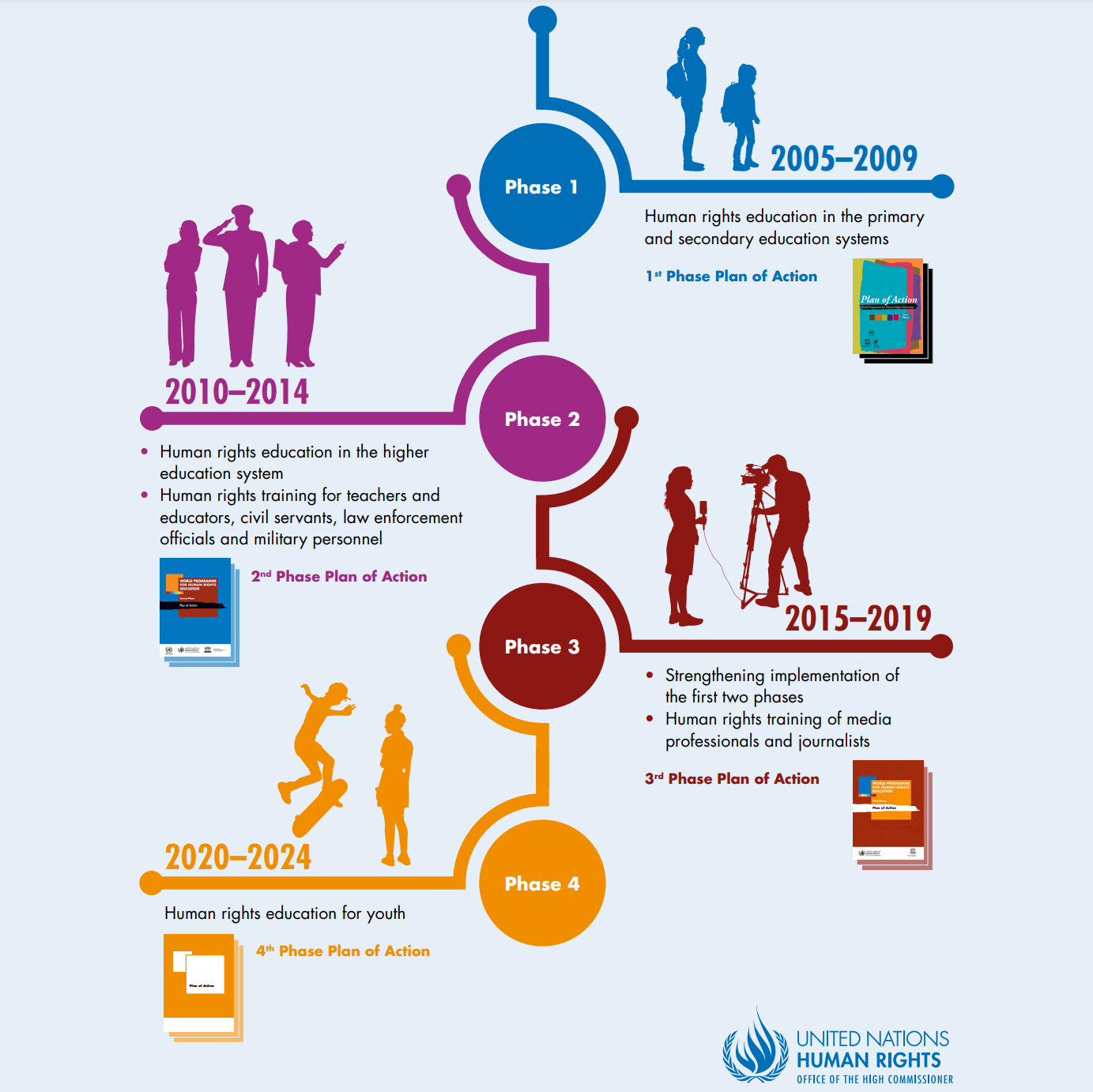
    In her presentation Felisa shared statistics regarding the increase of human rights education in schools worldwide and the reasons for its importance in schooling including its emphasis on social justice (from the community level up to the global level) and a solution to school concerns such as bullying, the integration of minorities, xenophobia and complacent democratic participation. In addition to sharing examples of human rights education in countries other than the U.S., Felisa shared with the Los Angeles educators the multi-faceted ways in which human rights principles might be integrated within schooling systems. These areas, based on the categories developed within the framework of the World Programme for Human Rights Education, are policies and laws; the learning environment of schools (including methodologies of instruction); curriculum; the professional development of educators; and evaluation and assessment.

    Her keynote presentation was followed by a hands-on session with educators on how to promote a city-wide strategy for HRE in schools and teacher training colleges. Human Rights Watch will be forming sub-committees in order to support follow-up at the policy level as well as in teaching practices.

    Watch the video Video clip


    back to top
    Bookmark and Share
    HREA Trainings
    HREA Publications
    Subscribe
    Enter your email address to subscribe to HREA mailing lists.
    RSS Feeds

    Upcoming e-learning courses

    HREA is offering ten e-learning courses in the second semester of 2008, including new courses on "Genocide: What role for international aw?" and "Le Monitoring des droits de l'homme". Find out more about these and other upcoming e-learning opportunities.

    Report of the European Regional Meeting on the World Programme for Human Rights Education available

    The Final Report of the European Regional Meeting on the World Programme for Human Rights Education which took place in Strasbourg, France on 5-6 November 2007, is now available online. Read further.

    Experts meet at HREA to discuss good practices in human rights education

    A team of European experts met at HREA's offices to discuss the "Compendium of good practices in the area of human rights education, citizenship education and education for mutual respect and understanding" that HREA is currently preparing. Read further.

    HREA offers new thematic e-learning courses

    In 2008, HREA will offer three new thematic e-learning courses in addition to its annual specialised distance learning courses. The three courses are: "Mainstreaming Human Rights", "Terrorism, Human Rights and Human Security", and "Genocide: What Role for International Law?". Read further.

    How You Can Help

    HREA supports human rights and educational institutions in transitional democracies to develop human rights curricula and training materials. With your donations we can continue to assist our colleagues in their important work. Find out how you can contribute.

    Tell a Colleague

    If you have colleagues who may be interested in HREA Online, HREA's quarterly e-mail newsletter, please forward this newsletter to them. They can sign up here.


    Accessibility | Copyright | Publications | RSS | Privacy | FAQs