HREA / Education and training in support of human rights worldwide HREA celebrates 15 years
About Us | HREA News | E-Learning
Learning Centre Resource Centre Networks
Spanish French Russian Russian German Portuguese Italian Chinese Arabic
 
HREA Online - April 2009

In this issue

- From the HREA staff: HRE at the UN Human Rights Council
- First issue of Research in Human Rights Education Papers
- HREA hosts expert meeting on framework policy on EDC/HRE in the European Union
- HREA integrates 'Browsealoud' into website


From the HREA staff: HRE at the UN Human Rights Council

Dear Colleagues and Friends of HREA,

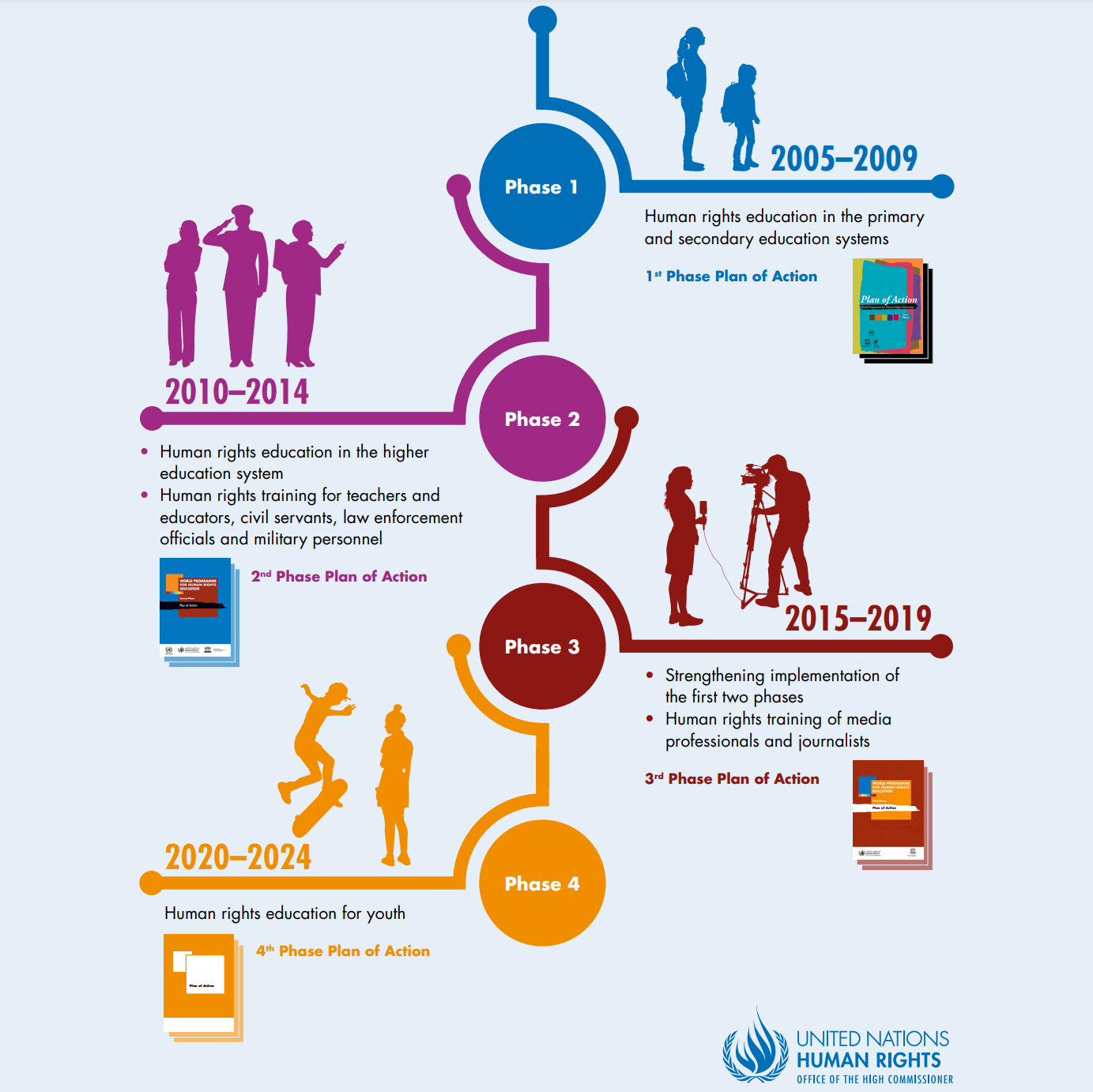
Human rights education (HRE) featured prominently at the 10th session of the UN Human Rights Council in Geneva last month. On the agenda were the next phase of the World Programme for Human Rights Education and the UN Declaration on Human Rights Education and Training, which is currently under development. The UN's highest human rights body requested the High Commissioner for Human Rights to consult with UN member states, national human rights institutions and intergovernmental and non-governmental organisations on the possible focus (target sector or thematic area) of the second phase of the World Programme to begin on 1 January 2010. The Council also encouraged member states to start taking steps for the preparation of their national evaluation reports on the first phase, to be provided to the United Nations Inter-Agency Coordinating Committee on Human Rights Education in the School System in early 2010.

The Council endorsed an initiative by several countries to organise a seminar to further reflect on elements to be included in the draft UN Declaration on Human Rights Education and Training. It requested the Advisory Committee, its subsidiary body, to submit its draft for consideration at the Council's thirteenth session in March 2010.

HREA, together with the NGO Working Group on Human Rights Education and Learning in Geneva, prepared a Joint Statement to the Human Rights Council, which was endorsed by over 400 NGOs from around the world. The endorsers of the Joint Statement urged the Council to determine a sector/area to be focused upon in the second phase of the World Programme for Human Rights Education. It also called on the Council to consider important elements of the draft UN Declaration on Human Rights Education and Training, including clarification of the concept of duty-bearers and rights-holders regarding implementation of human rights education and training; inclusion of a monitoring system to ensure implementation by duty-bearers; financial resources; and the acknowledgement of the important role that civil society and NGOs play.

HREA will continue to keep you posted on the latest developments on international advocacy for HRE.

With very best wishes from the HREA Board and staff,

Felisa Tibbitts
Executive Director

First issue of Research in Human Rights Education Papers

Research in Human Rights Education PapersThe first issue of the Research in Human Rights Education Papers Series is now available in digital format. The paper is a comparative study on models of human rights training. "Human Rights Training for Adults: What Twenty-six Evaluation Studies Say About Design, Implementation and Follow-Up" examines trainings for human rights defenders, police officers, government officials and the general public and makes recommendations on how to improve programme delivery, research and documentation practices.

Through the Research in Human Rights Education Papers Series, HREA hopes to encourage more research on the impact of human rights education and make the results available to practitioners, to academics and to funders. In 2009, HREA will publish three more papers, including a study on the impact of a nationwide human rights education curriculum in the framework of the UNESCO Associated Schools Project in Germany and a review of existing theory about human rights education.
Download the research paper.

HREA hosts expert meeting on framework policy on EDC/HRE in the European Union

On 28 March the Democracy and Human Rights Education (DARE) Network organised a one-day seminar "Towards a coherent framework policy on EDC/HRE in the European Union". Nine experts on education for democratic citizenship (EDC) and human rights education (HRE) met in Amsterdam to prepare a strategy for a Hearing in the European Parliament on April 2nd. During the meeting, hosted and organised by HREA, participants discussed recent developments around the Council of Europe Charter on EDC/HRE, the World Programme for Human Rights Education and the draft UN Declaration on Human Rights Education and Training.

"Towards a coherent framework policy on EDC/HRE in the European Union"
The main agenda item, however, was the preparation of "talking points" and recommendations for the session with the Education and Culture Committee of the European Parliament and the necessary follow-up to this Hearing. The seminar was attended by the following persons: Bryony Hoskins (Institute of Education, UK), Daniela Koralova (Partners Bulgaria), Georg Pirker (AdB, Germany), Elisabeth Roehrlich (Demokratiezentrum, Austria), Anne Stalfort (AdB, Germany), Hugh Starkey (International Centre for Education for Democratic Citizenship, UK), Wim Taelman (VORMEN, Belgium), Ruud Veldhuis (Instituut voor Publiek en Politiek, Netherlands), and Frank Elbers (HREA).

HREA integrates 'Browsealoud' into website

HREA made great strides towards creating an accessible website for people with disabilities or language barriers. The HREA website is now enabled with Browsealoud software, which reads web pages aloud for people who find it difficult to read online. Reading large amounts of text on screen can be difficult for those with literacy or visual impairments.

HREA is committed to making its web content as accessible as possible so that everyone can benefit from our educational resources and online courses, and participate in community-building related to human rights education.

Visitors to hrea.org can download Browsealoud software for free. After installing Browsealoud, all content on HREA's website can be listened to.

download Browsealoud


HREA has taken other steps to make its website more accessible. For instance, text size can be increased and there is alternative text for all images. Alternative text means that users with text-only browsers or assistive technology can still access information contained in images on our site. Web visitors who have visual perception issues can also choose between four background colours.

Like the UN Convention on the Rights of Persons with Disabilities, HREA believes that it is vital to ensure that, "persons with disabilities can exercise the right to freedom of expression and opinion, including the freedom to seek, receive and impart information and ideas on an equal basis with others”.

Visit our Accessibility page for details, including links to tools and information on making the web more available to people with disabilities.


back to top
Bookmark and Share
Also available in:
Español
Français
Pусский
HREA Trainings
HREA Publications
Subscribe
Enter your email address to subscribe to HREA mailing lists.
RSS Feeds

Upcoming e-learning courses

HREA is offering thirty e-learning courses in 2009, including new courses on minority rights; the European Union and human rights; monitoring women's rights; national human rights institutions; and business and human rights. The application process for courses offered in the third trimester (September-November) has started. Find out more about these and other upcoming e-learning opportunities.

HREA obtains UN consultative status

On 27 January 2009, HREA was approved for special consultative status with the Economic and Social Council (ECOSOC) of the United Nations. The ECOSOC consultative status will enable HREA to submit written statements and make oral presentations during UN meetings. Read more >>


HREA partners with Victoria Police


HREA is assisting the Victoria Police (Australia) with the professional development of its staff on international human rights standards and policing. The training programme includes several on-line courses on human rights litigation for police prosecutors and an intensive five-day workshop in Melbourne for police station managers and inspectors. Read more >>

HREA contributes to Encyclopedia of Peace Education

HREA's Director Felisa Tibbitts wrote an article for the Encyclopedia of Peace Education. The entry provides a succinct overview of the field of human rights education (HRE). It covers the history of the HRE movement, definition, expansion of HRE in schools, rationales for HRE, pedagogy of HRE, the development and conceptual framework for HRE, and the future of HRE. Learn more >>

HREA trains staff of SOS Kinderdorf International

In preparation of SOS Kinderdorf's "Leaving Care" campaign, HREA organised a three-day professional development workshop on advocacy for SOS Kinderdorf International staff at its headquarters in Innsbruck, Austria. Read further >>

Index 2007-2008 Global HRE List available

The Index of all messages distributed on the Global Human Rights Education listserv from June 2007 to May 2008 is now available in PDF format. The Global Human Rights Education listserv is a moderated forum on which over 6000 human rights defenders and educators from 185 countries share new resources, methodologies, strategies and lessons learned. Download the Index 2007-2008

Invite a Colleague

If you have colleagues who may be interested in HREA Online, HREA's quarterly e-mail newsletter, please forward this newsletter to them. Subscribe >>


Accessibility | Copyright | Publications | RSS | Privacy | FAQs