HREA / Education and training in support of human rights worldwide HREA celebrates 15 years
About Us | HREA News | E-Learning
Learning Centre Resource Centre Networks
Spanish French Russian Russian German Portuguese Italian Chinese Arabic
 
HREA Online - July 2009

In this issue

- From the HREA Staff: HREA's new strategic plan
- Consultation on the World Programme for Human Rights Education
- Arab Institute and HREA launch 19th Anabtawi summer school
- Panel on 'Schooling in Post-Conflict Societies: The Role of Human Rights'


From the HREA staff: HREA's new strategic plan

Dear Colleagues and Friends of HREA,

Last week HREA concluded a four-week, on-line consultation on the second phase of the World Programme for Human Rights Education (You will find more about the consultation in the article below.) We organised this on-line forum in order to help ensure broad input from civil society members.

Enhancing human rights education as a field through policy input, development and advocacy is one of the four goals in HREA's Strategic Plan for the period 2009-2013, which was approved by HREA's Board last month. The other three goals of our new Strategic Plan are:

* Expand training in human rights and human rights education for human rights defenders, legal professionals, development and humanitarian workers, staff of inter-governmental organisations, educators and other professional groups.

* Continue to support human rights educators through information services such as the on-line HRE Library, the Global HRE listserv, networking and other professional development opportunities.

* Enhance human rights education as a field through research & evaluation, and offer evaluation services to international NGOs and inter-governmental organisations sponsoring human rights/HRE programming.

The Strategic Plan calls for an expanded offering of trainings in order to contribute to capacity building of the human rights field. Through workshops, long-term training programmes, summer courses, e-learning courses, and 'blended' programmes we hope to meet the growing demand. In the meantime we will do our best to continue to serve you with high-quality programming.

With very best wishes from the HREA Board and staff,

Frank Elbers
Director of Programmes


Consultation on the World Programme for Human Rights Education

UN human rights logoOn 16 June HREA began a four-week, on-line consultation on the Second Phase of the World Programme for Human Rights Education. The main purpose was to identify potential target sector(s) and/or theme(s) for the Second Phase, which will commence on 1 January 2010. This on-line forum, which concluded on 14 July, involved broad input from civil society members, with contributions from 46 NGOs, academic institutions and other civil society actors representing 26 countries. The exchange among listserv members helped to foster a common understanding and consensus about the direction of the HRE movement.

The result of the on-line forum was an analytical report on progress made towards the achievement of the objectives of the First Phase of the World Programme, including accomplishments, remaining shortcomings and needs, and recommendations for action for the Second Phase. HREA submitted this report to the Office of the UN High Commissioner for Human Rights (OHCHR) in Geneva, which is responsible for coordinating the World Programme.

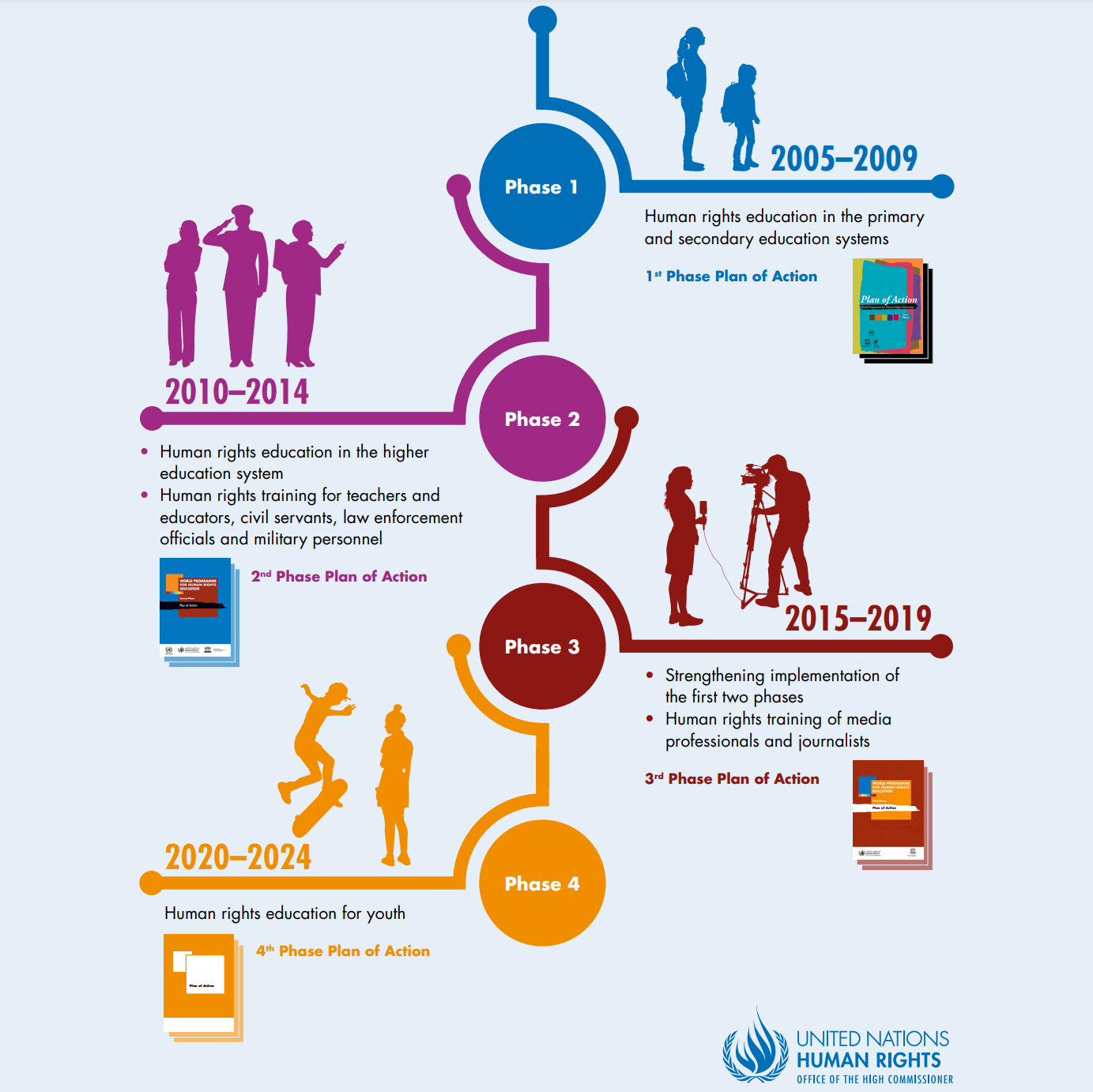
On 10 December 2004, the General Assembly of the United Nations proclaimed the World Programme for Human Rights Education (2005-ongoing) to advance the implementation of human rights education programmes in all sectors. Building on the achievements of the United Nations Decade for Human Rights Education (1995-2004), the World Programme seeks to promote a common understanding of the basic principles and methodologies of human rights education, to provide a concrete framework for action and to strengthen partnerships and cooperation from the international level down to the grass roots.

The World Programme is structured around an ongoing series of phases, the first of which covers the period 2005-2009 and focuses on the integration of human rights education into the primary and secondary school systems, intended as a comprehensive process touching upon policy and legislative measures, teaching and learning processes and tools, the learning environment and the education and professional development of teachers and other school personnel. Learn more >>


Arab Institute and HREA launch 19th Anabtawi summer school

The 19th edition of "Anabtawi", the annual summer school for Arab human rights defenders began on 22 July. Anabtawi traditionally consists of a two-week intensive training workshop that takes place in Tunis annually and is organised by the Arab Institute for Human Rights (AIHR). For the first time an on-line component was added to the training, with the assistance of HREA.

Thirty-five participants from 13 countries in the Middle East and North Africa participated in six weeks of an intensive on-line course that began on 1 June and concluded on 12 July. This course introduced participants to the main UN human rights mechanisms, the basics of international humanitarian law, and familiarised them with other Anabtawi participants and the trainers.

HREA and the AIHR added the pre-course on-line phase to Anabtawi in order to save time during the summer school by introducing participants to basic human rights knowledge on-line so that during the summer course more emphasis could be placed on skills development and strategising. The on-line phase also allowed for more reflection and in-depth engagement with the theory and background of human rights mechanisms and human rights law.


Panel on 'Schooling in Post-Conflict Societies: The Role of Human Rights'

HREA's Executive Director Felisa Tibbitts organised and moderated a panel on "Schooling in Post-Conflict Societies: The Role of Human Rights" that took place at Harvard's Kennedy School of Government on 9 April. Ms. Tibbitts was a Human Rights Fellow at the Carr Center for Human Rights Policy (Harvard University) in the 2008-09 academic year.

Human rights education practitioners working in South Africa, Latin America, and the Balkans presented curricular policies in post-conflict societies and critically assessed their potential for contributing to healing, reconciliation and the development of democratic societies. Panelists were: André Keet (University of Fort Hare; former Deputy CEO of South African Human Rights Commission), Natasha Djuricic (Civic Initiatives, Serbia), and Ana María Rodino (Inter-American Institute for Human Rights, Costa Rica).

One of the main conclusions of the panel was that educators in all regions are insufficiently prepared to teach human rights education and that concerted efforts should be made to integrate HRE within teacher training institutions. The panelists anticipate presenting and publishing their papers in additional venues.

Read Felisa Tibbitts' introductory remarks >>


back to top
Bookmark and Share
HREA Trainings
HREA Publications
Subscribe
Enter your email address to subscribe to HREA mailing lists.
RSS Feeds
Upcoming e-learning courses

HREA offers a course on gender mainstreaming
HREA is offering eleven e-learning courses in the first trimester of 2010 (1 February-20 April), including courses on gender mainstreaming, human rights-based programming, human rights advocacy (in Arabic), human rights litigation, human rights of migrants, international tribunals and world courts, monitoring children's rights (in French), national human rights institutions, and the UN Human Rights Council. Find out more about these and other upcoming e-learning opportunities.

HREA partners with Asia Pacific Forum of National Human Rights Institutions

HREA and the Asia Pacific Forum (APF) signed a partnership agreement to meet the specific training needs of APF members. HREA will provide online courses that will complement the APF's existing training programmes and provide a 'blended' learning experience for participants.

HREA trains Commonwealth Secretariat

Marlborough House, Headquarters of the Commonwealth Secretariat in London
HREA conducted an introductory training workshop on 29-30 June for staff of the Commonwealth Secretariat at its headquarters in London. The aim was to increase capacity in implementing a human rights-based approach in the Commonwealth's programming. Read more >>

HREA Director keynote speaker at regional forum in Vilnius

The OSCE convened government and civil society experts from Belarus, Latvia, Lithuania, Moldova, Poland, Russia and Ukraine met in Vilnius to discuss accomplishments of human rights education (HRE) for young people. HREA's Executive Director Felisa Tibbitts facilitated workshop sessions and delivered introductory remarks. She identified several accomplishments in HRE in the region. Read more >>

HREA testifies before European Parliament

Frank Elbers, HREA's Director of Programmes, testified before the European Parliament on 2 April. On behalf of the DARE Network he briefed members of the Culture and Education Committee about the current developments in education for democratic citizenship and human rights education in Europe. Read more >>

DARE Spring Academy

From 2-9 April, 29 young educators met in the German Harz Mountains for the first DARE Spring Academy. The participants, working in various fields related to youth work, came from nine European countries. Read more >>

HREA Web Survey results

Take our Web survey
HREA thanks all who completed our website survey. We learned that most of you are interested to find more teaching and learning resources on the website. Read more >>


Accessibility | Copyright | Publications | RSS | Privacy | FAQs