| by Felisa Tibbitts
Presentation prepared for Norwegian Human Rights Centre, Oslo, 16 November 2006
Introduction
It's a pleasure for me to be with you today and I thank the Norwegian Human Rights Centre for their generous offer to allow me to present some thoughts on universities and human rights education. In my professional life, I direct Human Rights Education Associates, an international NGO that focuses on human rights education and training. Thus, I have a certain perspective, even bias, that I should share. My confession is that I do not deal directly with universities as a matter of course. I do involve university faculty in training events and projects that we organize, but I do not generally focus on higher education as a sector for reform, with the exception of pedagogical high schools or teacher training institutes. Thus, it's been a pleasant challenge for me to consider more directly the relationships between higher education and the human rights education movement.
My bias is that as an activist, I believe that we need to measure all of our human rights education efforts against the ultimate goal to contribute to the human rights movement. I will try to maintain this standard in addressing three major themes in my presentation today: the rationale for focusing on HRE in higher education; observations about the growth of HRE in universities over the last ten years; and the future of HRE in higher education.
1. The Rationale for Focus on Human Rights Education in Higher Education or How does higher education potentially contribute to the human rights movement?
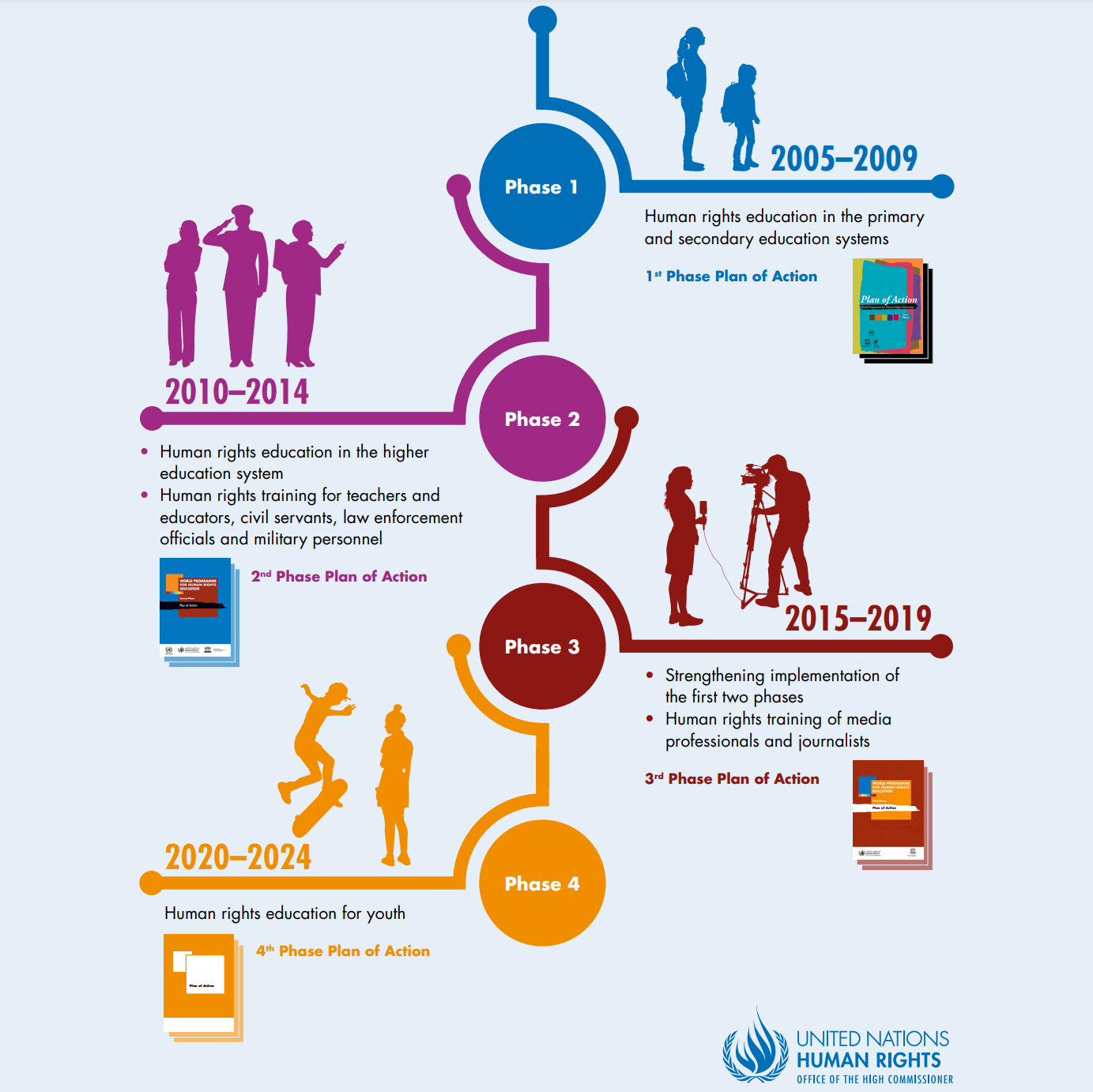
We know that in theory it is a responsibility of governments to inform their citizens about these treaties they have signed and ratified. This is a rather minimum obligation tagged on to UN documents that have not generally been taken seriously by governments. The United Nations has, through the Decade for HRE and now the World Programme for HRE, underlined the necessity of organizing HRE at all levels of schooling in order to strengthen respect for human rights and fundamental freedoms. The global community of HRE, in turn, have continued to develop clear methodological criteria for quality HRE - such as use of active or "democratic" methods of learning - and the linking of education with action. These qualities of HRE are intended to help ensure that HRE be carried out in a way that supports the cultural practice of human rights, not just information dissemination.
A clear link between HRE at the university level and the human rights movement is the students.
The integration of human rights themes into university courses, programs of study and other opportunities to see the application of human rights principles to current events or daily practice helps to promote understanding for the value of human rights and to use a human rights "lens" in interpreting societal and global problems. HRE can foster a sense of social responsibility.
These same students will then be better positioned to integrate human rights values into their professional careers. [Albania- primary schools - future Prime Minister] I am speaking not only about general Social Science education but also professional schools, such as public health, education and law.
Students can become engaged in civil society and activism.
[In many countries, human rights activists are spawned in law schools, and you will find concerted efforts to promote HRE in law schools, especially through practice-based, or clinical legal education. Read from clinics brochure.]
The other clear link between HRE at the university level and the human rights movement are the professors.
Professors, especially legal scholars, can influence the promotion of the rule of law (as is the hope in China and other developing democracies) through giving advice to administrative and legislative bodies.
[Earlier this year I carried out an evaluation for UNICEF on their juvenile justice programming in Southeast Asia. Many of these countries are developing are just in the process of developing policies and laws that recognize the category of juvenile offenders and their special needs and rights as minors. In situations where new laws and ways of thinking about social problems are emerging, the role of individual scholars can be enormous. In each of the countries we studies - Indonesia, Mongolia, the Philippines, Timor Leste and Papa New Guinea - academics played a key role in developing juvenile justice policies and draft legislation in cooperation with government officials.]
Another way that academics can influence the human rights movement is through scholarship. Studies, new ways of thinking about issues - these can in fact have a great deal of influence, and not only in academia. Think about the work of Paulo Freire - about praxis and HRE. We would probably not understand HRE the way that we do now if not for his work in Brazil and his writing. I would like to point out that his insights came from practice, and I will return to the important link between the field and academic within human rights education later in my presentation.
United Nations calls for HRE for all sectors of society and all levels of formal schooling, including at the university level.
I think that within the HRE in general there has been much less attention to the university as within the secondary school sector. I think that there are philosophical and structural reasons for this. First, the tendency for HRE as a movement historically has been to focus on schools and popular education. The UN engages primarily with governments and the NGOs - who are usually the ones pushing HRE - tend to be engaged with other NGOs, key government actors or in-service training institutes. Universities can also be seen as closed, tending to operate rather autonomously from the government and the NGO sector institutionally. So, one can observe that the Decade for HRE, showed a slight tendency towards creating new human rights training, documentation and research centres (Philippines, Tunisia, France) rather than systematically addressing human rights curricula at university.
So I think it would be fair that although one can easily see the importance of HRE at the university level, it has not been so easy to envision working institutionally with universities and higher education. I also want to recognize that the NCHR, and its counterparts in Sweden and Denmark, have rather uniquely tried to bridge the worlds of the human rights movement, NGOs and academia. In fact, we have seen incredible strides in HRE in higher education, which I turn to now.
2. Observations about Growth of Human Rights Education in Universities since 1995
Before I begin to describe the growth of HRE in universities, I want to formally recognize that HRE at the schooling level in any country will depend on a number of conditions. These include the will of the government and the political situation of the country- e.g., post-conflict, accession, so-called stage of democratic development.
Political contexts do create specific opportunities and challenges to HRE and this applies also at the university level. I mention this because even though I will try to make generalizations about HRE in higher education, in fact the opportunities and challenges may be quite different from country to country. I think that this may be made clearer today in the presentations of some of the other speakers who are working in China and Indonesia.
I will present three dimensions of the growth of HRE in universities: institutional, the professors, and the students.
INSTITUTIONAL-THE UNIVERSITY
Although information is incomplete, the indications that are available suggest that the presence of human rights studies on campuses in many countries has increased over the last 10 years. Although it is simply impossible to document the number of new courses that have human rights themes or majors that now include a human rights emphasis, an Internet search shows increasing numbers of human rights centers and institutes. My impression is that this proliferation is happening especially in Europe and the Americas, but university-based human rights centers certainly exist in every region. There are also increasing numbers of UNESCO Chairs in Human Rights. The growth of HRE at the university level coincides with the institutionalization of HRE across a range of institutions, including schools, inter-governmental agencies, humanitarian groups and especially within the NGO sector. Again, to some degree this will depend upon the country and region we are speaking about, but I believe that this is a general trend across all regions.
The presence of human rights studies can take a range of forms, almost a hierarchy of forms. Human rights centers (which provide multi-function services to students interested in human rights) - including internships, conferences, speaker series, film series. These centers are often linked with NGOs and are key to forwarding student contact with the human rights movement. Courses and minors/majors of study addressing human rights.
There has certainly been an increase in the number of human rights centres in North and South America as well as in Europe. Full masters programs in human rihgtsare becoming more common. For example, just last year the Council of Europe helped to establish a European Inter-University Centre for Human Rights and Democracy.
The presence of HRE on campuses is also diversifying. Some of the oldest human rights centers are affiliated with the school of law, especially in the U.S. Consider the University of Minnesota, Chicago, Yale, American University. But the newer ones are tending to be inter-disciplinary or they are located in specific professional schools, such as schools of health, education and public policy as I mentioned earlier. These examples I find rather exciting, also, because they involve not merely about studying the human rights framework but considering the implications of this ethical framework to professional practice. There are some indications that an inter-disciplinary approach to HRE is genuinely happening in scholarship although opportunities to promote more genuine inter-disciplinary approaches remains. The NCHR sponsors a range of human rights-related research, including the legal sector, the social sciences, and development. However, universities are, by their nature, compartmentalized and this has resulted somewhat in a discipline-specific approach.
Women's human rights has broken new territory, however. A theme-based approach to humanrights scholarship, as NCHR has done, will help to promote inter-disciplinary approaches - for example, looking at pluralism and development. I believe that the concept of the rights-based approach will be key to helping to forward human rights thinking and values into a broader range of disciplines.
PROFESSORS
Resources for university professors to draw upon in designing human rights programs continue to increase, include syllabi/human rights textbooks, networks, trainings and scholarly publications. What seems to have been key is the university-to-university contact. Again, the needs for/availability of these resources will depend upon the region, but the trend is upwards. This is important, because professors who teach about human rights do some from a compassionate point of view. They also need support and nurturance personally and professionally. And they can get creative ideas from interacting with one another.
If there are increasing numbers of courses and programs related to human rights, then we have to assume that there are higher numbers of professors involved in this endeavor. STUDENTS
Although I researched numerous sources, I could find no central source that collates the number of students enrolled in such courses or the impact of such involvement in students' knowledge, attitudes or involvement in human rights activities. Numbers seem to be increasing in the Americas and Europe. On one website I found that there were 10,000 students in the UK registered for degree programs in human rightsand international relations. The increase in numbers of students enrolled in the Americas and Europe may be related to the sense that there are now more job opportunities in this area - work in international organizations and public sector management. With increasing globalization and integration of human rights into non-legal sectors.
3. The Future of Human Rights Education in Higher Education
Reminder: needs will vary by country and region.
Research on the impact of these programs on students and their adult careers and volunteer activities would be helpful.
Also, some gathering of information about the presence of human rights at universities, by nation and region, and any qualitative differences in approach that we may find. What kind of courses, degree programs and human rights-related programming are offered? What kind of teaching methods? What about views towards human rights or the topics that can be addressed. What are the most pressing needs? Most likely, what is happening at the university level in any given country is an intersection between the countries political culture, educational traditions, and other local factors. [I read an article recently about the International Institute of Human Rights in Strasbourg, which has a summer program for university professors in human rights. This course is offered in several languages, including Arabic, so you might imagine that some interesting contrasts can emerge across participants. According to the person who wrote this article, the informal discussions of the Arabic-speaking participants had to do with the compatibility of human rights with the Koran. The Asian and African participants were most concerned about access to online materials so that their students could carry out research projects.]
to think about who is training these professors. Here is my question: how are they trained? I think it's an interesting question, especially if we consider the question of praxis and HRE. Human rights educators have made clear claims that we should be engaging in human rights education in order to promote a certain kind of care about social problems and readiness to become actively involved. Is this a view shared by all professors teaching human rights? And are they using pedagogical methods that help to forward this aim?
Need to continue to expand the scope of human rights at the university so it is not primarily legalistic. Rights-based approach may present an opportunity. The interaction between inter-governmental agencies, international development organizations and academia may be particularly helpful in forwarding this. I believe that we will also see more scholarship on this in the future, following a few years of concentrated work within the agencies such as UNESCO to flesh out practical guidelines for this work.
Need to support expansion and sustained institutionalization within the university. This means: training opportunities for faculty (in-service while promoting at graduate school level); reward for research and teaching in the field; sample syllabi and available teaching materials. We can't forget that HRE is generally underfunded as compared to human rights activism.
I believe that it is crucial for the integrity of HRE and for the improvement of practice in different sectors to foster two-way learning between the university and the NGO sector. Simply put, university professors and their students will benefit greatly from knowing about the human rights, and HRE work of NGOs involved in the daily work of promoting human rights. The only way to bring human rights alive in the imagination of students - especially those students from privileged backgrounds - is to talk about the realities. On the other hand, NGO can also benefit from the thinking that is carried out in universities. Theories and analysis can but result in new perspectives and deeper understandings of field work. Recently, an analysis was carried out on the Global HRE listserv that HREA sponsors that looked at globalization, online communication, professional and North-South dialogue. The analysis was really important for confirming an operating principle of our program - that of promoting lateral dialogue between human rights educators.
And universities have students. NGOs need inspired and talented young people to help support their work. I think it is a win-win situation to promote a link between academia and NGOs, and in conclusion I would like to share an exciting idea that has just been developed at HREA in cooperation with the Scholar Ship Research Institute.
We are at this moment developing an International Colloquium that would examine comparative approaches to HRE, but specifically looking at the links that currently exist, and might exist, between university-level HRE and grassroots HRE instruction. This has to do with curricula but other links that may be made for students. Some of the areas we anticipate exploring are: human rights and globalization; transnational human rights; values in human rights education; evaluating HRE; and instruments and implementation of policies to promote HRE.
I think there remain many opportunities for promoting HRE at the university level. I thank you for your attention and I look forward to our discussion.
| |